Part of the Obama stimulus package involves several billions of dollars dedicated to HSR, otherwise known as High Speed Rail, which travels more than 110 mph.
While that would be a wonderful improvement, the rest of the world may soon be advancing even beyond their rail wheel HSR reality.There's something new in the works.
It's called MagLev...meaning Magnetic Levitation...and prototypes have already been built in Europe and Japan. It's a train that floats on a magnetic field, and can go nearly as fast as a jet airplane.
Why not look into MagLev as a viable HSR option? It's at least THREE TIMES as fast as current HSR operating in Japan and Europe, and would help unclog our highways and airports.
Plus, there's no moving parts on the train...IT DOESN'T EVEN HAVE AN ENGINE. The propulsion system is all in the track and its electronics. The magnetic field in the track essentially "pulls" the train along the track.
That being said, it's more energy efficient, with zero emissions. It has less impact on the landscape, and can work with current transportation corridors, such as our freeway system, to get through the more remote mountain passes, etc...not to mention the opportunity we have that our Japanese and European bretheren don't.
We can start fresh and build it from the ground up, and it will give us a viable transportation option for generations to come...AND, in terms of the trains themselves, the maintenance costs are totally at a minimum, as there are no moving parts...and isn't that something all Americans love? MINIMUM MAINTENANCE COSTS? Helloooooo, politicians!!!
So, IMO the ends justify the means.
If we're REALLY going to go green, why not bypass the rail wheel phase and simply jump into the wave of the future? Then we could really lead the pack and set a new standard.
Here's a video that explains what the MagLev train is all about.
Over the course of the last couple of years, following a mini-reunion in 2007, I've had conversations with several classmates from my middle school days (it was called junior high back then)...and since my last day of junior high occurred 25 years ago this month, this is as appropriate a time as any to reflect.
When these conversations occur, many stories bubble to the surface...updates on how other former classmates are doing...running into so-and-so recently, and what they're up to...musings on this and that...reflection on those times 25 years after the fact.
In these conversations, old teachers are brought up too. The good...the bad...and the ugly. After 25 years of retrospect, as adults many of us have established a hierarchy in our minds of where the good ones fit in, and we understand why they were good. Their influences are appreciated and in many cases set an example for us to this day.
In most cases the bad, "not so good," or "challenged" teachers are given the benefit of the doubt...it's easy to see, in all fairness, that either they weren't cut out for teaching, and while they may have done some things that they'd get fired for these days, they meant well and were performing to the best of their ability.
Some had bad tempers. For example, there was the one home room teacher who would snap on students and pick them up in their desks...and turn them upside down to dump the student onto the floor...or throw the student across the room in their desk. Sounds harsh? It was...and I even had the privilege of being dumped out of my desk once...but I realize I was probably being difficult, and hold no grudge whatsoever against this teacher. When this man was level-headed, he was reasonable...and fair...and didn't pick favorites...or if he did, he didn't make it obvious.
Then, in these conversations, all roads of discussion seem to lead to a particular P.E. teacher, who we'll refer to as Mr. B. This is where things get REALLY interesting.
Even 25 years after the fact, this teacher represents a point of differing opinions amongst former classmates, and the reason is very simple. Mr. B, who had power and influence over boys and girls in their most critical years of development, played favorites...BIG TIME...and not only did he play favorites, but he bullied those who weren't athletic, focused on using their intellect rather than their brawn, or ~ as I witnessed on occasion ~ called him on his shit.
Mr. B tried to propel his small-time career as a P.E. teacher and coach on the backs of student athletes, and in the process broke the fragile confidence of countless others. He dialed into, and gave only a damn, about the students who could serve his agenda. Everyone else was simply in his way, and you had better stay clear.
God help you if you had no athletic skill...because there was ZERO tolerance if you lacked such abilities. If you tried to stay low and blend in, he'd still find you and expose your weakness. In my case, I was athletic but not at "jock" status (there were several incredible athletes at the school who peaked early), so I was able to blend in the middle somewhere.
Even so, Mr. B still decided that I didn't fit into his larger agenda, and let me know about it...but I knew that anyway, and after some time (and conversation with my folks) decided that I really didn't care what the guy thought, and understood the coward that he was. What's so fascinating about this is that I don't recall doing anything to bring attention to myself with respect to this guy...I pretty much read early on that he was shady, and steered clear. However P.E. in the 7th, 8th, and 9th grade junior high system at the time was mandatory, so sooner or later your path was going to cross with an undesirable teacher such as this guy.
My situation has nothing to do with this post...in this case, I'm simply an observer. I wasn't really affected...but other boys got it far, far worse than me.
History provides some harsh lessons that are unacceptable even to this day.
...such as the story of the eradication of the Cherokee and the Five Civilized Tribes from their homelands in what was to become the deep south, to that of modern-day Oklahoma.
History has its harsh moments...and Native American history, in particular, has too many to count.
In addition to slavery, the treatment of Native Americans and the atrocities committed by settlers and the U.S. Government to this very day ~ issues that will eclipse four centuries when we celebrate the 400th Thanksgiving in 2022 ~ are utterly despicable and beyond shameful.
As Americans ~ Native, black, white, Latino, Asian, Middle Eastern or otherwise ~ WE ARE A POORER COUNTRY FOR WHAT WE DID TO OUR TRIBES.
Any way you slice it, the ancestors in the U.S. Government who called the shots on the destiny of tribal America were too drunk with power and greed to do the right thing; to have the vision to care about cultivating a culturally rich and harmonious tapestry of cohabitation and fairly negotiated sharing of the land rights pie between Native Americans and white America.
It's a far cry from the makeup of the United States we should have inherited.
This is the question that nobody seems to be able to answer: what exactly gave the United States the right, and entitlement, to remove these tribes from their homelands?
...and more importantly, what is the U.S. Government obligated to do to restore homeland rights to these tribes?
Anyone?
Tricky answer, huh? ...makes you squirm in your chair a bit there, huh?
Yes it does indeed...and you BETTER fucking squirm. That's THE LEAST you can do, is ponder the question.
The truth is that the relocation of the Five Civilized Tribes was never going to happen.
That is, until Andrew Jackson became President in 1829, when he made the removal of the tribes from their homeland his first order of business upon entering office. Those efforts resulted in the Indian Removal Act of 1830...which was passed in the Senate, but then determined to be unconstitutional by the United States Supreme Court.
Then Jackson did something that no other President in U.S. history has ever managed to pull off.
HE DEFIED THE DECISION OF THE U.S. SUPREME COURT.
Yep, he went ahead with his plans to remove the tribes anyway...which led to the Trail of Tears, which was akin to ethnic cleansing.
Why Jackson appears on the $20 bill is anyone's guess...we should burn one of those reserve notes everytime it passes through our hands, or at least remove the asshole from the bill altogether. More on that issue another time.
What remains of a Cherokee and Five Civilized Nations homeland is now in modern-day NE Oklahoma.
For me, this is a tough history pill to swallow...and while I'm not Native American, I am working from some extensive personal experience with tribal matters.
However, I can't begin to imagine how descendants of those tribal folks involved in those atrocities and accounts of ethnic cleansing feel...or Native American folks in general, as everything is connected in the Indian World.
Maybe the U.S. Government should try asking them...and doing a bit more than simply apologizing and relegating them to the consolation prize of reservation lands.
Just a thought.
I have a few ideas on how such issues might be resolved in a peaceable, fair, and equitable manner...through some sort of negotiated and gradual land swap program spanning literally decades. Part of this involves the American government, State governments, and the American people redefining, in part, the concept of what land ownership is.
They're everywhere around us...and most of them never get the recognition they deserve.
More often than not their deeds and actions are overlooked altogether. In other instances, their fates remain unknown due to the risks they take...such as Tank Man (left) from the 1989 protests in Tienanmen Square...and don't forget the tank driver who refused to run him over. He's a hero too.
For a very long time ~ for decades, essentially, in the latter 20th Century ~ society put heroes on pedestals that were attached to their feats on the playing field or in the movies.
In nearly every instance, the measure of heroes involved physical feats in the spotlight and statistical benchmarks rather than the feats of everyday bravery, smaller acts of humanity, and accounts of kindness that would go virtually unnoticed.
Then, on 9/11, everything changed and we were humbled.
We took a second look at the definition of a hero. Sadly, it involved the deaths of hundreds of brave and courageous NYC firefighters and police officers, in addition to innocent civilians, to reshape that focus.
I believe the message was delivered and taken seriously.
I think there's real signs that refocusing has held steady since September 2001...at least in my mind.
We celebrated Sully Sullenberger, the pilot who successfully and gracefully landed a crippled airplane into the Hudson River right before Obama's Inauguration Day.
Refusing to take the spotlight in the weeks following the crash, Sullenberger would ricochet all the attention and adulation directed at him into his copilots and crew, giving them all the credit. He praised the passengers for remeining calm and following protocol. He recognized the ferry boats that arrived as first responders. He expressed regret over injuries one of his crew members suffered and was quick in his effort to take responsibility...but WE weren't going to let him get away with that.
Through all of Sullenberger's humility, however, he was willing to cough up a small furball...recognizing what the actions of he and his crew, and the events surrounding the successful crash landing, meant to the rest of the country.
Sully is as wise as he is humble. He understands that the world is hungry ~ even desparate ~ for heroes. REAL heroes. People who face adversity and take action, no matter what the foreseeable cost...or it can take the form of simple acts of kindness.
In this last week, I've recognized and continue celebrating one of my personal heroes; Marvin Webster, a man whose professional basketball career shot like a star across the sky and whose life was sadly beset by unfair tragedy and ended way too early.
His acts of kindness, attention, and inspiration to me as a 9-year-old kid are what help to define him ~ not what he accomplished on the basketball court ~ although there was much to be said for his accomplishments in Seattle between 1977-78.
I realize I've been gushing about this fella all week, and I will continue to do so...so here it is again.
Thank you Marvin...again.
Then, just today, our beloved Navy Seals rescued Captain Phillips, who was the head of a cargo ship crew on its way to Kenya when Somali pirates took him hostage and held him for the better part of a week.
The only reason we were dealing with one captive was due to his selfless acts that allowed his sailors to go free and continue onward to Kenya while he stayed behind to try to negotiate his release.
These are some of the heroes we hear about, and they're the sorts that we need out there.
We need these individuals of great character and their stories to be known to us to inspire the hero in the rest of us.
Here's more footage of Marvin...if you go to the 45 second mark, you'll see his classic jump shot. While he was known more as a defensive player and shot blocker, when he turned up the heat he was unstoppable.
He led the Sonics with the most points in this Game 7 of the NBA Finals, and led the team in what became the franchise's first appearance in the championship series. What an amazing run.
It's a vid that focuses on the Washington Bullets, but Marvin's all over the place...notably just before the 3 minute mark. The 1:50 mark also mentions Marvin's contributions, and after that it's interesting to see the Marlboro Man on top of the Seattle Center cube.
...and the music, dear God. Holy dated 70s porno music, Batman! Where's the first Dire Straits record when you need it?
I'm stunned and saddened. One of my all-time heroes has passed.
I just found out today that former Sonic Marvin Webster died this last Monday. You can find details here, and here's a second article that expands on his illnesses that most likely contributed to his early passing here. Here's another article from the Baltimore Sun, the newspaper of Marvin's hometown, but I'd advise you to read that after this post if you want to hear good news first.
This is really upsetting.
For those who kept track of the Lenny Wilkens-led Sonics teams of the 1970s, you will know who Marvin "The Human Eraser" Webster is. While the best year of his career was with Seattle (1977-78), it was short-lived and only for one season. Ironically, his departure to New York in 1978 brought power forward Lonnie Shelton to the Sonics, who won the NBA title that following year.
But that's a little history that only a few in the general public are barely aware of, at best.
It really hurts to read the insensitive AP headlines (not surprisingly) that describe how he was found "in a hotel bathtub." Sure, it's true, but it's not like this guy died in the manner of Kurt Cobain...he actually struggled with health issues for most of his life (Hep A and B, I believe), including during his time as a basketball player. He also struggled, appears, with some unimaginable heartache.
Those at the AP show us once again how they have no soul and are interested in selling only newspapers. They'll never understand that these stories involve real people with meaningful lives and admirers who respect them.
I have a different story to tell about Marvin...something a bit more personal. Marvin Webster's one of my all-time heroes and one of the few people in this life that I've ever looked up to.
Uh, literally. As an eight year old kid I looked up to him...and up...and up...as he stood tall at 7'1"...
...but his character stood much taller. In an industry peppered with attitudes, infidelity, and domestic troubles, he was THE diamond in the rough.
Needless to say, they don't make them like Marvin anymore.
Marvin Webster was one of the good guys, and the consummate teammate. Totally selfless and kind. He gave to people, on and off the court, without any expectation of receiving. Putting aside what he accomplished as a pro hoops player, he represented the best of what society has to offer in terms of his off-the-court selflessness and citizenry.
In 1977 my family moved from Oregon back to their native Seattle when Dad switched jobs...and it just so happens that Marvin Webster and his lovely wife were our next door neighbors. It was a difficult year of adjustment for me, as I'd left behind some buddies in Oregon I had built some connections and rapport with, even at the ages of seven and eight. I didn't have any siblings, so I had to go out and seek companionship.
When my Dad figured out who was next door, he introduced himself. The families warmed up to each other and started spending time together.
It's hard to describe what it was like having Marvin next door...the only way I can describe it was that IT WAS LIKE HAVING SUPERMAN NEXT DOOR, LITERALLY...with a uniform and all. Except this Superman didn't wear a cape and tights, he wore a MUCH cooler uniform...and proudly wore #40.
In my world, #40 belongs to Marvin...the way #42 belongs to Jackie Robinson and #3 belongs to the Babe.
We got to know the Websters; Marvin, Maderia, and Marvin Jr. while in utero (she carried him for most of her term in Seattle)...they were very approachable, gentle, and kind. Our two families spent time together and went out to dinner. It was a relaxed hang...nothing was ever forced. We were brought into the Sonics community and spent many days at basketball games sitting with the player's wives under one end of the court.
I developed a personal relationship with Marvin, and his presence served as a guiding light through the difficult adjustments I was making from being the new kid on the block. He wasn't a father yet, so he was able to spend some time and gave me attention. I even opened a Christmas gift from him; an illuminated tracing table is what I recall. I'd stop by their house and visit him on his off days, when he was usually lying diagnolly in their king-size bed resting watching television ~ because that's the only way his long frame would fit on it.
My most memorable moment with Marvin occurred once when he was hosting a Sonics gathering at his home, and my folks were over there as part of it. It's come to be known as the "cherry Coke incident."
During the gathering, which took place one evening, Marvin offered to come next door and check in on me. In an effort to replicate what was known at the time as a "Roy Roger" (not sure if they're called that anymore), I had decided that I was going to attempt to make a cherry coke by melting a cherry life saver in the microwave oven in a bowl...I figured it would melt and I could just pour the contents into a glass full of Coke, right?
Sure...there's the developed and imaginative brain of a kid who's just turning nine.
Needless to say, the experiment failed. The bowl cracked in the microwave just as Marvin came by to see what was going on.
Welcome to signs of fatherhood, Marvin!
He helped me clean up the mess, and I had to settle for a Coke without the cherry in it. My folk's stories have echoed that Marvin went back to the party and entered the room full of Sonics and partygoers, shaking his head. When he explained what had just happened next door, apparently everyone was in stitches and kid antics were one of the focal points of discussions the rest of the night.
The Cinderella story of that year, Marvin and his teammates came within one game of the NBA championship in 1978, when they lost at home in Game 7 to Washington's team, which was then called the Bullets.
Later that same year, we had a heartbreaking day when Marvin and his wife packed their things and left for New York. I remember it vividly; waving goodbye to my hero. I quickly learned one of the ugly sides of the sports business ~ that being traded and moving onto other teams is no fun for some of us ~ notably a young nine year old fan.
Ironically, the Sonics won the NBA Title the following year...but IMO Marvin deserved a ring as much as some of the other fellas, as his emergence the year before ~ along with the great coaching of Lenny ~ gave the team the confidence and momentum they carried all the way to the '79 title.
The Sonics teams from 1977-80 are mostly forgotten due to the emergence of Bird and Magic, and then Jordan, that came afterward.
Since 1979, the Sonics never won another title, though they came close in the 1990s during the Michael Jordan years and the Bulls' reign. The team has since relocated to Oklahoma City and became the Thunder.
Now Marvin Webster, one of my all-time heroes, has passed...and way too young at 56. How Marvin carried himself outside of the game, his great character, and the impact he had on other lives won't be forgotten...certainly not to this nine year old kid.
The ripple effect of his inspiration and kindness is what helped propel my own involvement as a basketball player. It's part of what inspired my father to coach hoops.
Marvin was a hero in every imaginable way someone can be a hero. He was quiet and humble. He spent time, cared for, and related to the little guy...the little kid next door...and that was only the beginning ~ didn't end there.
He showed up at birthday parties. He freely and gladly gave autographs to my friends. He checked on me as a babysitter would. We laughed together and were silly. I greeted him at the airport when he came back from a road trip, and then drove home with him. I hung out with him on off days. I sometimes wonder if it was real or just a dream.
That was my time with Superman.
The last time we spoke was when he came back into town when he was with the Knicks, 3-4 years later, when I was starting Junior High and entering my teens. He called the house and asked to speak with me on the phone...the conversation went something like this:
Me: "Hey Marvin."
Marvin: "Wow! Listen to you! You're starting to sound like a man!"
Me: (embarrassed) "Oh no, not really. How are things going with the Knicks?"
Marvin: "Well they could be better. It's been a tough season."
Me: "Yeah, it's tough for the team here too...not like the old days. I miss you."
Marvin: "I miss you too."
The conversation from there is spotty, but it continued for a little more.
I just wish I'd had the opportunity to speak with him again...I had thought of trying to reconnect with him online, but didn't know where to start. I wish I could have told him some of these things in person...and reading his comment at the very end of the article this post is linked to only breaks my heart even more.
I have a pair of old John Wooden special edition basketball shoes that he gave me as he was leaving for New York. I wore them for the first two seasons I played basketball...as a shot-blocking center in 4th and 5th grade.
Boy was he a cool fella. Marvin, you are remembered, and cross my mind every other day at the very least. Thank you. You'll be sorely missed.
I suppose I'll need to apologize in advance for this post...as apparently I'm slow on the uptake.
I could really use some help here.
So I crack open a bottle of Vitamin Water this morning, the latest item of consumption in my rotating cornucopia of breakfast options.
As I'm drinking it, I notice the recycling label...you know, that triangular arrow thing? I always enjoy looking at the triangular arrow recycling logos...it seems to emit an "Oh yeah!" from me every time.
Next to the triangular arrow recycling logo on the bottle of Vitamin Water was a little text referring to said logo, and it stated this:
"30 may be the new 20, but green is definitely the new black. please recycle."
Huh?
Okay...other than being annoyed by the lack of capitalization (which seemed to be a consistent theme throughout the language on the bottle, WTF?), what is this "black" thing all about?
Again, I apologize for this.
Help me out here...I guess I have few points of reference to go by, at least anything that would be obvious to me...what does it mean when it refers to "black" like that? Black in a fashion sense, as in look-at-my-cool-chic-new-spendy-outfit-while-I-walk-around-Manhattan? Is it a Goth thing? ...or black as in a middle schooler "emo" sense? In a beat generation or Velvet Underground sense? What am I missing here? When was black ever it's own unique fad, besides the clothing folks wear to funerals and the day after the world ends when they lose an election?
OMG, I just saw another saying using black in that sense online just now! "Frugality is the new black." it said... Auuuuuuuuuuuuggggggggghhhhhhhhhh!!! I'm being attacked!
I want to believe that I didn't crawl out from under a rock this morning. I recall the fads of the 70s...I recall bell botton jeans...I recall synthesizers and neon being big in the 80s...and I recall purple and teal being big in the 90s...but black? No idea. All I can think of is when the Velvet Underground emerged in the late 60s and all of Lou Reed's schtick, and I believed their black clothing served as a counterpoint to the hippie movement at the time...or perhaps it's always been around, and always been cool? ...and what would you call that, "permachic?" Did I just invent a new word? Am I losing my mind?
So back to the issue at hand. When was black cool? ...and moreover, when was it cool enough to evoke enough status to make its way into pop culture sayings like that, to the effect that it appears on a bottle of Vitamin Water in the year 2009?
Can someone give me a literal explanation of this? Explain it to me like I'm a 2nd grader...and no, I cannot read between the lines.
Please help, it's issues central in the control room today.
This is an update on Neil Young's continuing Lincvolt project, which I believe has been ongoing for a number of years now...you can get a better idea of it in the vid below.
It's also worth checking out some of the related videos on this project.
...is to represent an environmental chronicle of sorts --- an ongoing report card on the status of our national and planet-wide ecology --- and discussion of what our political landscape brings to bear on it. Together we can help affect change!!!
I might occasionally noodle into other topics that keep me amused, such as music and a little sports commentary, just to mix things up a bit.
Be sure to keep visiting the p-patch to see what kind of new shtick is growing. The best garden parties are here! ...FYI it's pronounced "pee-patch" (not trying to encourage indecent exposure in the garden either, so keep your pants zipped please)
A polar bear's plea...
"Hey human dummies! When you screw me out of my homeland, you screw yourself!" Wow! I didn't know a polar bear could talk --- but I hear what he's saying --- do you?
It's so darn oooooooold around here!!! Where's Rip Van Winkle?
Majestic Old Growth in Washington State mystifies the senses.
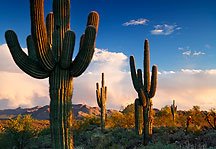
The "superintendents of the desert" silently rule in God's country...
...the mighty saguaros reach for the heavens - and echo the timeless heritage of Arizona.
Ahhh, it's the spidery Ocotillo cactus...
...my favorite desert plant... another survivor, and its floral blooms in springtime are amazing... uh, I hope the biker doesn't wipe out. That would hurt.
Birdy!!!
An Arizona Cardinal taking advantage of some leisure time (when it's not getting checked midfield by an angry Seahawk). Is Zorn in the room?
The Oregon Coast
Some of the most amazing views and rugged coastline on the planet. Proves that Mother Nature is the greatest artist - hands down.
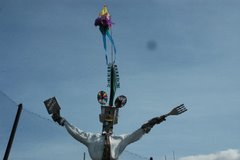
another "lunatic fringe frightener," a p-patch scarecrow.
I've gotta get me one of these! This garden party probably rocks, and it looks like a bit of a freak show, like something left over from a Sun Ra concert. My kind of folk.
Hints on how to behave in the p-patch - a loose "civility policy" if you will...
Say what you mean, and mean what you say, but don't be mean when you say it. If you're one of those p-patch bullies, then we'll turn the hose on you.
This site is intended for constructive dialogue and expression of views - let's keep it that way and have some fun!
Personal attacks are totally unnecessary, and those doing so in the garden may trip over a sprinkler hose, step on a rake, or even get a shovel thrown at them (but hey, I didn't do it).
SWEVA'S P-PATCH is a blog. If you're new to this sort of forum, I'd advise you to read some postings and walk around the garden a bit before posting any comments. That way you'll have more fun at the garden party!
so Sweva, I still don't get it. What in the heck's a "p-patch?"
A p-patch is a small community garden. The ones I'm familiar with are in Seattle, and from what I can tell managed in a coordinated effort between the city and residents since they legally belong to the public. The city actually has a job dedicated specifically to the p-patch program, "Community Garden Liaison." While they may be on private property, they are sanctioned and protected through easements and cannot be wrecked by a said property owner - even if they're blocking street access from garages. Many of the p-patches are nearly microscopic in size and tucked into odd little corners around town. I'll try to find a link that has more insights and see how the program got started.